05/23/2026
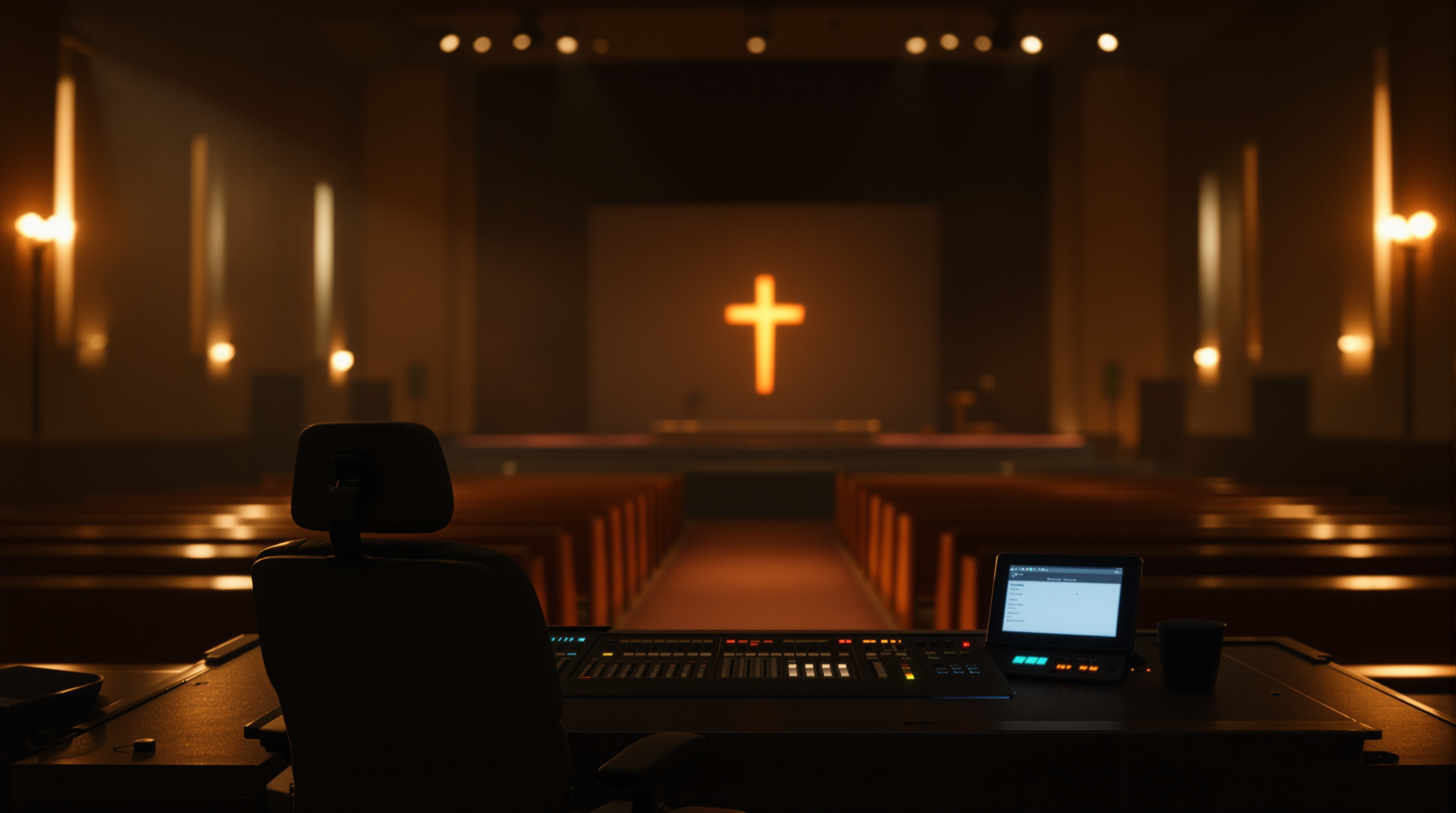
The one person who knows your church livestream just texted that they cannot make Sunday. Here is the 48-hour triage plan, the one-page run book that lets anyone step in, and how to build a real AV bench so a single phone call never threatens your service again.
It's Thursday night. You're shutting down for the day and a text comes in from the one person who knows how to run the livestream: "Hey, family stuff came up — I can't make Sunday."
Your stomach drops. Not because Sunday is ruined, but because you suddenly realize a thing you've been quietly avoiding for a year: the entire online ministry of your church is sitting in one person's head, and that person just walked out the door for the weekend.
This is not a tech problem. It's a people problem dressed up as a tech problem. Here's how to get through this Sunday, and how to make sure it never feels like this again.
Why this keeps happening to church AV teams
The average volunteer retention rate sits around 65 percent, which means roughly one out of every three people who serve in your church will stop in any given year. AV teams get hit harder than most. The work is invisible when it goes well and very visible when it doesn't. Volunteers burn out quietly, then they vanish.
There are usually three reasons a church AV team ends up balanced on one person's shoulders:
- The setup is too complicated for anyone else to learn in a reasonable amount of time.
- The person who runs it likes being needed (this is human, not a flaw).
- Nobody ever asked anyone else.
You can't fix the third one this weekend. But you can fix the first two within a month, and you can survive this Sunday with a few hours of work tomorrow.
The 48-hour triage plan
You have until Sunday morning. Here is what to do, in order, starting Friday.
Friday afternoon — call the person who quit. Not text. Call. Ask them to sit with you for one hour, on or off camera, and walk you through what they normally do. Take notes. Record the call if they're okay with it. This is not about guilting them into showing up Sunday — they already told you they can't. It's about getting the knowledge out of their head and into a document before it leaves the building.
Friday evening — write one page. A literal single page. Not a binder. Title it "Sunday Stream — What to Do." Use short numbered steps. "Turn on the camera. Press this button. Open this app. Sign in with this account. Click Go Live. If audio sounds wrong, check this cable." That's it. Tape it to the AV cabinet.
Saturday morning — find a substitute. Don't post a general appeal in the church group chat. That almost never works. Make three personal phone calls instead. Personal invitations get accepted and stick around at roughly three times the rate of public asks. Aim the calls at people who already show up early, are calm under pressure, and can follow written instructions. You're not looking for tech enthusiasts. You're looking for reliable adults.
Saturday afternoon — do a dry run with the substitute. Twenty minutes. Walk them through the one-page document. Hit Go Live on the stream privately. Watch it on a phone. Hit Stop. Done.
Sunday morning — get there early. Be in the room. Don't run the stream yourself unless you have to. Let the substitute do it with you watching. They will be nervous. Your job is to be calm and answer questions, not to take over.
That's the triage. Now the longer-term fix.
Make the technology itself volunteer-friendly
Most church AV systems are built by people who enjoy building AV systems. Those people are not the people who will run it on Sundays after the original builder moves to another state or has a baby.
A volunteer-friendly setup has a few traits worth fighting for:
- One button to start the stream. If there are seven steps to go live, you don't have a livestream — you have a hostage situation.
- No login that depends on one person's personal account. This is the silent killer. The person leaves, you lose access to your own stream.
- Clear labels on every cable. Sharpie and masking tape. Not pretty, but it works.
- A quick-reference card on the wall. Lamination optional. Use it.
This is also the place to be honest about your platform. A lot of churches livestream to YouTube and then spend Sunday mornings worrying about whether the worship songs are going to get muted by ContentID. That's not a worker problem — that's a platform problem that you've handed off to whoever happens to be sitting at the AV booth. There are tools built specifically for churches, like Fluger, that don't run your audio through copyright detection at all, which is one less thing your volunteer has to know how to fix when something goes wrong.
The same logic applies to where your members watch. If your livestream lives on your YouTube channel, getting Grandma to find it every Sunday is a tutorial call she doesn't want to take. A branded church app on iPhone and Roku — listed under your church's own name in the App Store and Roku Channel Store — removes most of the friction for the people you most want watching. And in case anyone's told you that getting on Apple's App Store means you need an Apple Developer account and a thousand-dollar annual fee plus six weeks of paperwork: it doesn't have to. Some platforms handle that paperwork for you. Worth knowing.
Build a bench, not a star
The actual long-term fix is to never again have a Sunday where one phone call can take down your stream. That means three people on the AV team minimum, with two trained on every job. Not "trained on the basics" — actually trained, with hands on the equipment, multiple Sundays in a row.
A few rules that work:
- Schedule any single volunteer no more than every other week. People burn out faster than you think. Half the schedule is half the burnout.
- Recruit by personal invitation, not public appeal. Ask specific people. "I think you'd be good at this. Want to try it for one Sunday with me sitting next to you?"
- Hold one "open house" Sunday a quarter. Invite the curious to sit at the AV booth and watch. Some of them will become your next bench.
- Check in one-on-one every few months. Not "how's it going?" — actually "are you still enjoying this? Honest answer." Catching burnout one conversation early saves you a panicked Thursday text.
A short and honest CTA
If your Sunday morning AV is one person away from collapse, the platform itself is part of the problem, not just your volunteer pipeline. Fluger was built for the volunteer who didn't sign up to be a sound engineer — simple stream setup, no ContentID muting on worship songs, and your own branded iPhone and Roku apps without dealing with Apple Developer paperwork. There's a 14-day free trial at fluger.tv/registration — long enough to see if it makes Sunday morning quieter for the person sitting at the AV booth.
Either way: write the one-pager this weekend. Future-you will be grateful.