05/09/2026
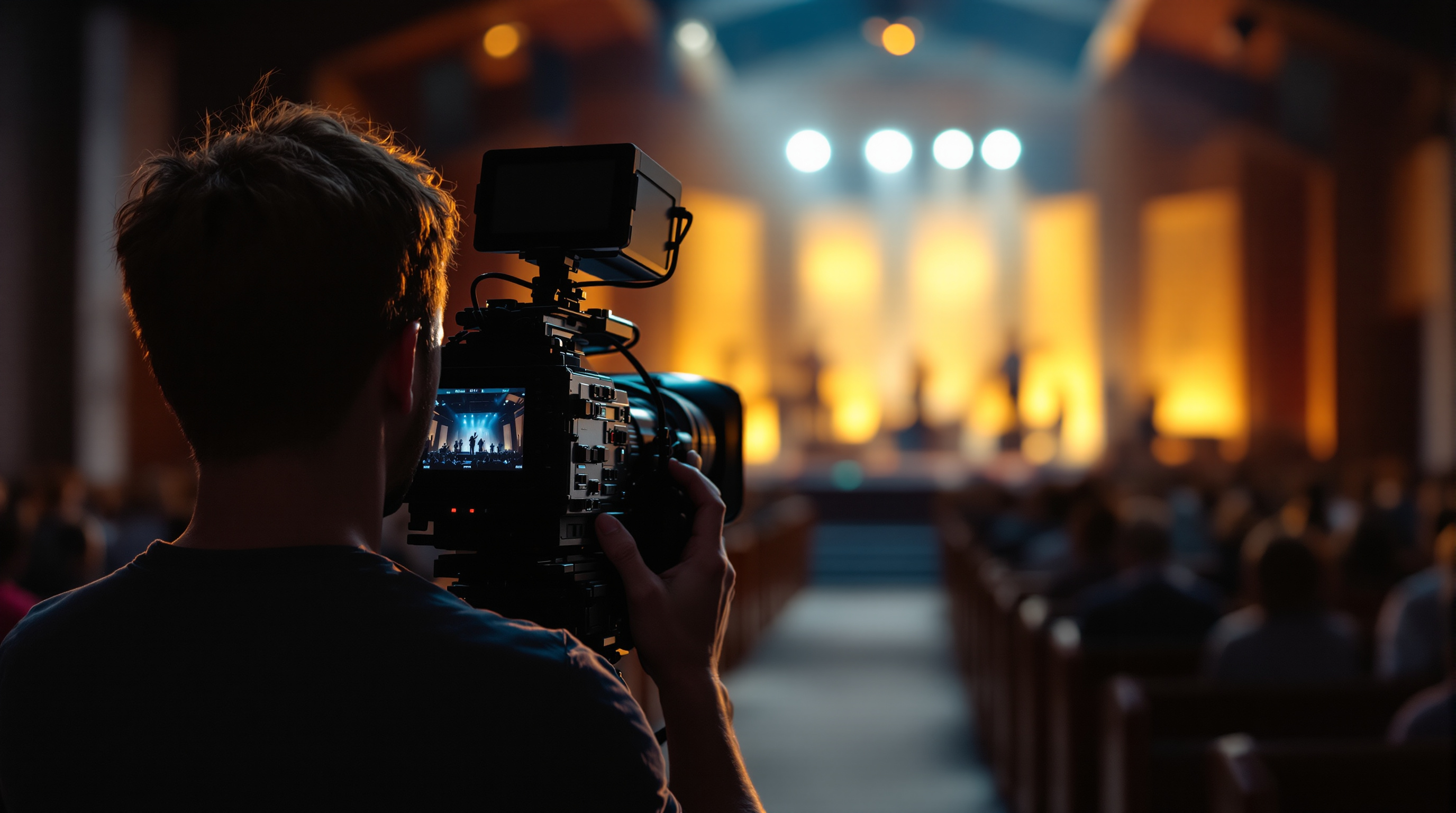
Most church streams lose the majority of their audience in the first 8 minutes. The fix is not better gear — it is what you put on screen between minute zero and minute two.
Seventy-three percent of your livestream viewers will leave in the first eight minutes.
That is not a guess. It is what shows up across most church streaming analytics. The average watch time on a 65-minute Sunday service is barely twelve minutes. Which means most of the people who clicked your stream never made it to the sermon, never made it to the offering ask, and never made it to "see you next week."
If that hits a nerve, good. Because the fix is not another camera or a fancier graphics package. The fix is what you put on screen between minute zero and minute two.
The brutal math of the first 90 seconds
YouTube and Facebook decide whether to show your stream to more people based on what happens in the first 60 to 90 seconds. If new viewers click and immediately leave, the platforms quietly throttle your reach. The same video, with a stronger opening minute, can get pushed to two or three times as many people the next week. Same congregation, same sermon, completely different ceiling.
This is not a hypothetical. It is how the algorithms work, and they do not care that you are a church.
So what do most churches put in those crucial 90 seconds?
A locked-off shot of an empty sanctuary. A countdown timer over a logo. A pre-recorded "Please stand by" graphic. Maybe some acoustic worship music quietly looping while the AV team tries to get the soundboard right.
All of that is poison.
Stop streaming an empty room
Here is a small experiment for next Sunday. Open your stream on your phone, with the sound on, the way a first-time visitor would. Watch it cold for two minutes.
If what you see is an empty platform, a bored thumbnail, or a "starting soon" placeholder, you have your answer. That is the experience you are handing to every newcomer. They do not know your service starts at 10:30 sharp. They do not know to wait. They came to see something happening, and nothing is happening.
Either do not go live yet, or have something on screen worth watching the second you go live. One or the other. The empty middle ground is where viewers go to leave.
A pastor on camera beats a logo loop every time
The single highest-leverage change a church can make to its livestream is fifteen seconds of a pastor on camera, before the music starts.
Not a sermon preview. Not a polished promo. Literally:
"Hey, glad you are here. We are going to worship together for about twenty minutes, and then I am going to talk about how Jesus handled fear in Mark chapter 4. If you are new, welcome. Stick around."
That is it. Filmed Saturday on a phone, dropped into the front of the stream. Or done live, walking out at 10:29.
It works because it answers the question every cold viewer is silently asking: what is this, and is it worth my next twenty minutes? An empty platform answers "no." A pastor with a face and a plan answers "yes."
Churches that try this typically see watch time go up by 50 to 200 percent. The mechanics are not mysterious. Viewers stay because something specific is being promised, and humans are wired to wait for promised things.
The audio mute that kills retention right when worship starts
Now imagine you have fixed the cold open. The pastor welcomes people, the band kicks off the first song, and at minute three the audio drops out for the next 45 seconds because YouTube''s ContentID system flagged the worship track.
Every retention chart you have ever seen has a cliff at that exact moment.
This is a structural problem with streaming on YouTube and Facebook, not a content problem. Their automated systems mute or replace audio on copyrighted music, including songs you have proper CCLI licensing for, because their bots cannot read CCLI. You can fight individual claims, but you cannot fight the cliff.
This is why some churches are stepping outside the YouTube and Facebook funnel for their primary stream and using a platform that does not run audio fingerprinting against worship sets. Fluger, for example, was built specifically so that worship songs do not get muted mid-service. It is not a magic solution to viewer retention, but it removes one of the worst retention killers churches face every single Sunday.
If you cannot move off YouTube right now, at least know that the cliff is real and watch your analytics for it. Audio is the leading indicator. People will forgive a shaky camera. They will not forgive silence during the chorus.
Where you stream changes who stays
Here is the deeper issue with depending on a public platform for your stream: every viewer is one swipe away from a thousand other things. The "Up Next" rail. The notifications. The thumbnail of someone else''s sermon competing with yours.
A growing number of churches are running their primary stream through a branded mobile app and Roku app under their own church''s name, not under a platform''s name. The math is straightforward. When someone opens an app called "First Baptist of Anywhere," they are already past the algorithmic gauntlet. There is no recommended content trying to pull them away. They came to watch you.
Fluger is one option that does this without a tech team. Branded iPhone, Android, and Roku apps published under your church''s own name, no Apple Developer account required, and the church owns the listing. There are other ways to get there too, but the principle holds regardless of provider: a viewer in your own app is dramatically more likely to make it from minute zero to minute thirty than a viewer on a public platform.
A four-item Sunday checklist
If you only do four things this week, do these:
- Do not go live until something is happening. No empty rooms. No countdowns over silence.
- Record a 15-second pastor welcome. Drop it at the front of every stream. Re-shoot it monthly so it stays current.
- Watch your audio analytics like a hawk. If you are losing viewers between minutes 2 and 5, that is almost always an audio cliff, not a content problem.
- Audit where your viewers are coming from. If 80 percent of your stream traffic is from a public-platform algorithm rather than from your own people, you are at the platform''s mercy.
None of this requires new gear. None of it requires a bigger AV team. It requires fifteen minutes of intent each week.
The first 90 seconds are not going to fix themselves. But they will reward you the moment you decide to take them seriously.
If you are rethinking how your church streams and want a platform that does not mute your worship songs and gives you branded apps under your own church''s name, start a 14-day free trial at fluger.tv/registration. No credit card. No Apple Developer account.