06/18/2026
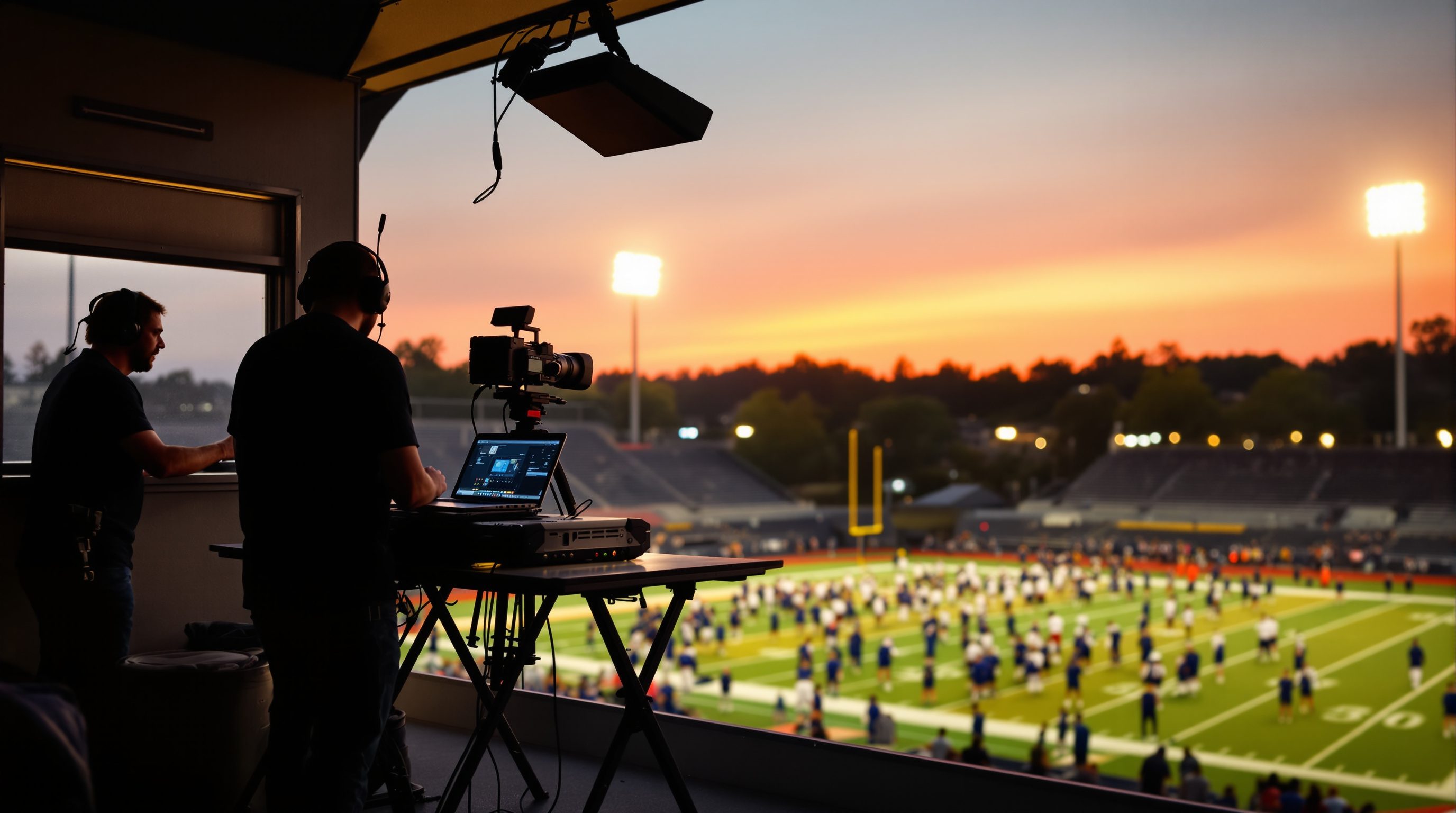
How high schools can turn their broadcast journalism class into the production crew for Friday night football and other home games — via course credit, a one-page MOU, and a branded streaming app that does not mute the marching band at halftime.
Most schools that stream sports are running a two-person operation: one paid AV staffer who knows the gear, and one volunteer parent who shows up when their kid is on the field. That works for a couple of marquee games. It does not scale to a fall calendar with football, volleyball, soccer, two cross-country meets, and a band invitational — all happening in the same six weeks.
Meanwhile, the building down the hall already has a production crew. They take attendance every day. They get graded on their work. Most schools just haven't connected the org chart.
The class is already there. The pipeline isn't.
A lot of high schools run some version of a broadcast journalism, video production, or media arts elective. Enrollment is usually solid because the class is fun and there's a clear deliverable — morning announcements, a YouTube channel, a yearbook video. Equipment varies, but the curriculum almost always covers camera operation, basic switching, audio capture, and post.
What's usually missing is a real-world pipeline. Morning announcements air to a captive audience of 600 students who have no choice. There's no feedback loop. Students don't get to find out if their work landed because there's no audience that opted in.
Live sports fixes that. It's high-stakes, time-bound, watched by people who care, and unforgiving of mistakes. It's the closest thing a high school can offer to actual broadcast experience. And conveniently, it's also the thing your athletic department is desperately trying to staff.
The fix isn't complicated. It's an MOU between the media teacher and the athletic director that says: starting Week 1, broadcast students staff varsity home games for course credit. The AD gets a crew. The teacher gets real-world assignments. The students get a portfolio that actually impresses college admissions.
What the students can actually run
You do not need to hand a freshman a TriCaster on day one. The credible breakdown for a typical Friday football stream looks like this:
- Camera 1 (game cam): wide tripod shot, follows the ball. Easiest position. Sophomore-friendly.
- Camera 2 (sideline / reaction): optional. Junior or senior with one season of experience.
- Announcer: play-by-play and color. Two students. The best position for kids who want sports journalism careers — and the one where the audience instantly knows whether the school takes this seriously.
- Producer / director: switches cameras, runs graphics, calls breaks. Needs the most training. Senior position, usually.
- Audio: mic management on announcers and ambient. Underrated. Bad audio kills a stream faster than bad video.
- Social / clips: cuts highlights during the game and posts them in real time. Perfect for a student who's already living on TikTok.
That's six roles. A class of fifteen rotating through over a season gives every student two or three shifts and a fair shot at every position. It also gives the AD redundancy when someone has a college visit or the flu.
The credit question is the unlock
This is where most schools stall. The teacher wants to do it. The AD wants to do it. Then someone asks how the students get compensated, and the conversation dies.
Three structures actually work:
- Academic credit baked into the syllabus. Game-day production counts as a graded project — same as a research paper would. Cleanest legally, easiest to defend to parents, no money changes hands.
- Work-study or independent study credit. Useful for students who've maxed out the elective but want to keep producing. Lets a senior earn additional credit for being your lead director.
- A small stipend out of athletics, if the school has booster funds. Optional. Pays a captain or two. Most schools skip this and lean on credit + portfolio.
Whichever route you pick, write it down. The reason these programs fall apart in year two is that the original teacher or AD leaves and nobody documented the arrangement. A one-page MOU survives turnover. A handshake does not.
What about the marching band copyright problem
Here's a wrinkle most schools learn about the hard way: if your stream lives on YouTube or Facebook, halftime can mute your audio. Marching bands play recognizable pop and movie scores. Automated copyright systems flag those songs and either silence the track or take down the stream entirely. Sometimes it triggers a strike on the school's channel that takes weeks to appeal.
There's no fix for this on YouTube. It's how their system works. The workaround is to publish to a platform that doesn't run automated content matching on your audio. That's increasingly why schools are moving game streams to their own branded apps — same stream, same students, no automated muting in the middle of the third quarter.
This is a real thing Fluger handles cleanly: streams run on the school's own branded app (Roku, iOS, Android), publishing the school's name and logo rather than living inside someone else's platform. There's no ContentID-style automated muting, and crucially — because the app is published under the school's own brand — you don't need to set up an Apple Developer account or wrangle Google Play. A volunteer parent can run the publishing side. The students stay focused on the production.
Year-round programming, not just game nights
Once the pipeline exists, you've solved a second problem nobody asked you to solve: the summer content gap.
A broadcast class that goes dark in June means an empty stream for ten weeks. But the same students who shoot football can shoot summer band camp, freshman orientation, theatre rehearsals, summer-league basketball, the senior video, the principal's back-to-school message, and the dozen other things the school produces anyway and currently posts nowhere.
A 24/7 channel needs roughly 168 hours of programming a week to feel alive. Your AV budget can't fill that. Your students, over four seasons, absolutely can.
The argument to bring to your principal
Start small. Two-week pilot. Pick one home game. Pair the media teacher with two seniors who already shoot well. Run the stream. Measure two things: how many people watched, and whether the students would do it again.
If the answer to both is "more than expected," you've got the basis for a real program. The AD gets crew they don't have to find or pay. The media teacher gets real assignments their students will actually care about. The students get something to show a college recruiter that isn't a class project. The community gets a stream that doesn't cut to black every other week because the volunteer parent couldn't make it.
The production team is already in the building. Give them a reason to stay late on a Friday.
Ready to give your students a real broadcast to produce? Start a 14-day free trial at fluger.tv/registration and launch a branded streaming app under your school's name — no Apple Developer account, no copyright muting on halftime, no platform fees taking a cut of your boosters.